
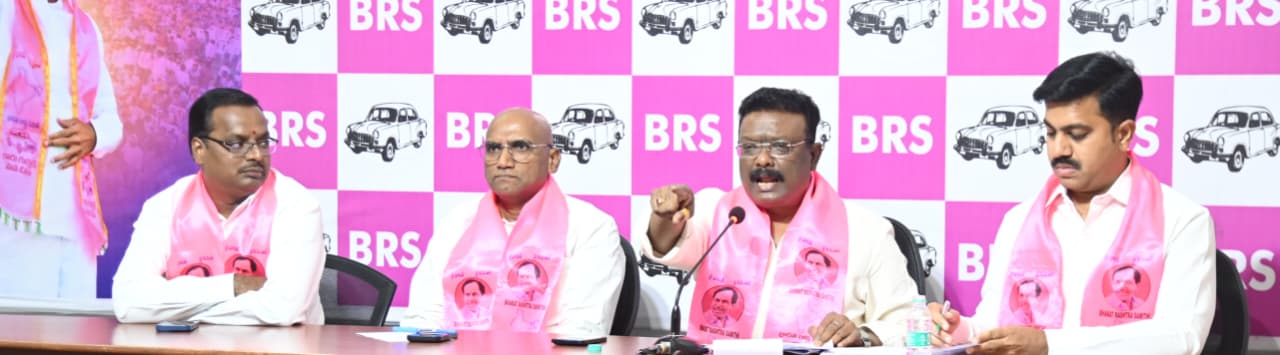
Hyderabad: BRS MLC Dr. Dasoju Sravan Kumar alleged that the tendering process in the Telangana Education Department has become completely illegal, manipulated, and corruption-driven. Addressing the media, he stated that in previous years, procurement for educational institutions was carried out through a decentralized system, where different residential welfare institutions independently floated tenders under the supervision of district collectors to fulfill their local requirements.
Under the earlier system, local small, micro, and medium enterprises (MSMEs), Padmashali weaving families, tailors, small steel industries, and other local businesses supplied materials to schools and hostels. This decentralized model ensured local employment, distributed economic growth, and opportunities for small entrepreneurs.
However, after Chief Minister Revanth Reddy came to power, the entire decentralized procurement mechanism was converted into a centralized procurement system without any consultation with opposition parties or stakeholders, Dr. Sravan Kumar alleged.
Also Read-
He described the new centralized procurement system as a “centralized corruption model” designed to control the entire tendering process through the Chief Minister’s Office and to award contracts worth thousands of crores to favored companies in exchange for commissions.
To implement this system, the government allegedly constituted a “Project Monitoring Unit (PMU)” through GO Ms No.17/202. Dr. Sravan Kumar stated that the PMU was placed under the control of the SC Welfare Residential Schools Secretary and that a non-IAS officer named Sharada was recently appointed to a key role in the system.
He pointed out that prestigious officers such as Nicholas, R.S. Praveen Kumar, and Ronald Rose had earlier headed these institutions, but now non-cadre officials who allegedly lack the courage to question irregularities are being placed in sensitive positions to facilitate corruption.
Dr. Sravan Kumar further alleged that tender eligibility norms were deliberately designed to exclude local small businesses and benefit a few large companies. According to the tender conditions:
Suppliers of uniform material must show an annual turnover of Rs. 250 crore
Suppliers of notebooks must show a turnover of Rs. 150 crore
Participants must produce solvency certificates ranging from Rs. 2 crore to Rs. 4 crore
He said such impossible conditions effectively prevent small Padmashali families, local manufacturers, and MSMEs from participating in the tender process.
He also pointed out major loopholes in the tender design. For items such as trolley bags, PT dresses, and blankets, the government reportedly stated that designs would be prescribed only after awarding the contract.
“How can companies quote prices without knowing the design specifications?” he questioned.
Similarly, he alleged that the government failed to declare any “base price” in the tenders. Normally, the government specifies a base price and suppliers quote lower competitive rates. However, in this case, companies were allegedly allowed to quote arbitrary prices without any benchmark, creating opportunities to artificially inflate contract values and facilitate corruption.
Dr. Sravan Kumar also highlighted a major legal contradiction. He pointed out that the Telangana government itself issued GO Ms No.1 in 2024 mandating that all government departments — including schools, police departments, hospitals, and other institutions — must procure cloth-related products only through the Telangana State Handloom Weavers Cooperative Society Limited (TESCO/TGSCO).
The objective of the GO, he said, was to protect nearly 40,000 handloom weaving families in Telangana by ensuring government procurement from cooperative handloom societies.
However, despite the GO remaining in force, the government allegedly bypassed it and introduced centralized procurement through the PMU system.
Dr. Sravan Kumar referred to the High Court case:
“Aadi Veeranjaneya Handloom Weavers Mutual Aided Cooperative Production and Sales Society, Kothawada, Warangal vs State of Telangana represented by the Chief Secretary.”
He stated that Hon’ble Justice Anil Kumar Jukanti clearly observed that under Article 43B of the Constitution, cooperative societies enjoy constitutional protection and that the government cannot ignore its own GO Ms No.1 while floating centralized tenders.


