
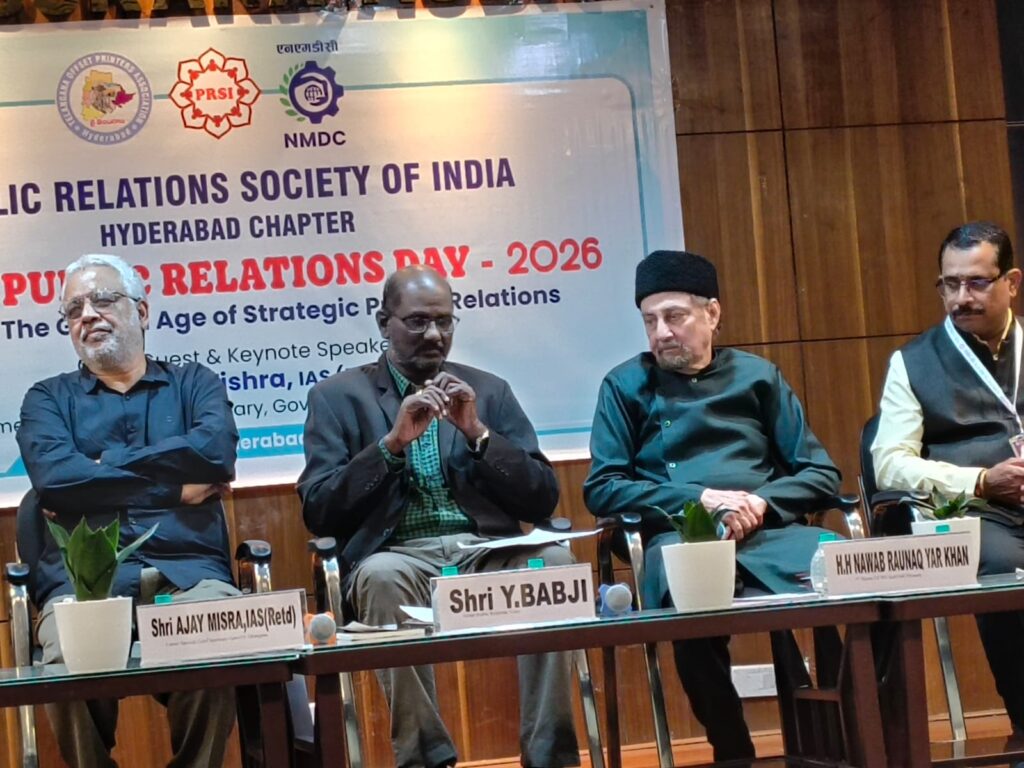
WORLD PUBLIC RELATIONS DAY
by Hyderabad Chapter of Public Relations Society of India
on 16TH July 2026 at FTCCI, Red Hills, Hyderabad
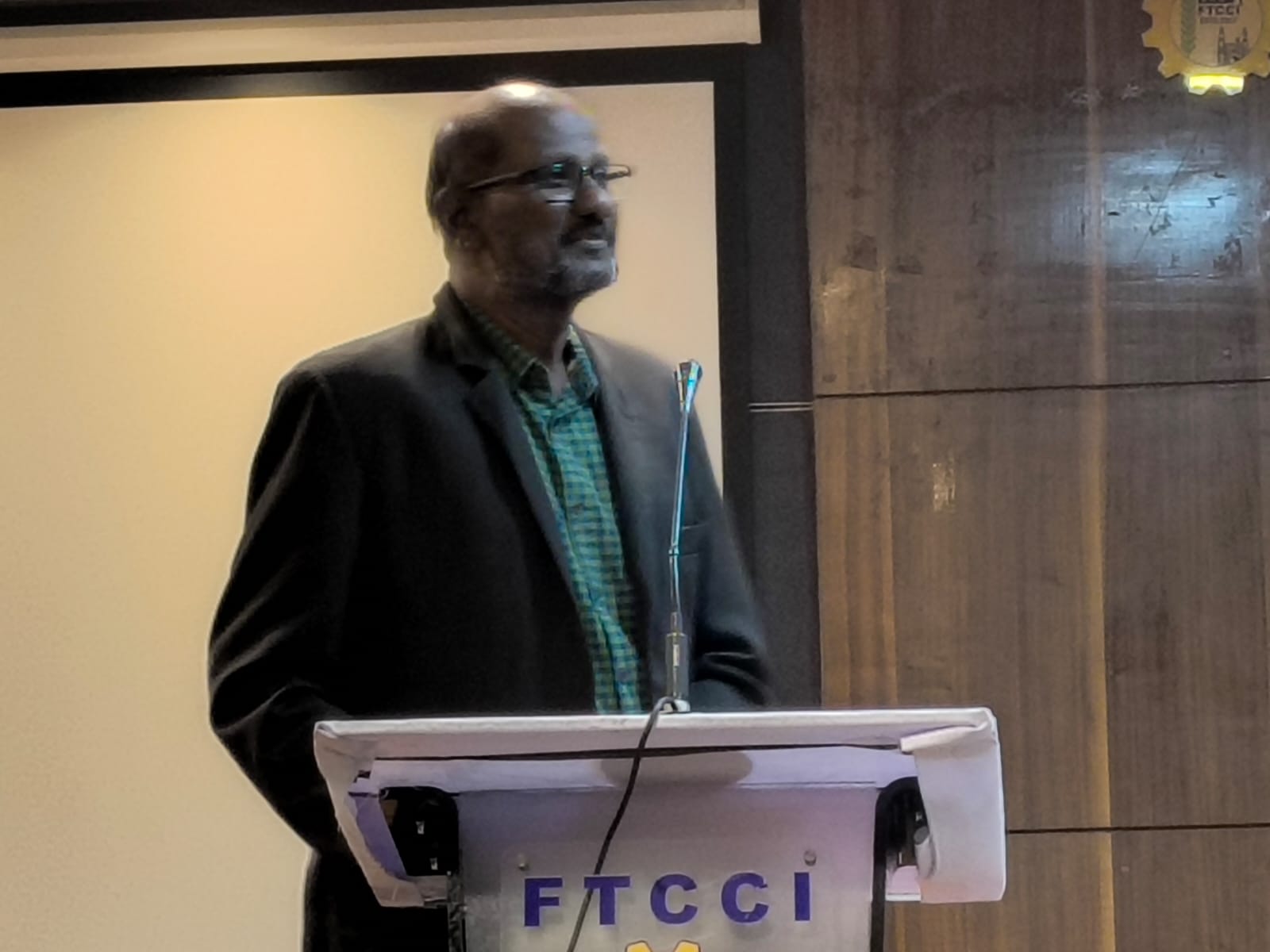
Presidential Address of Y Babji, Editor, Public Relations Voice
Dignitaries on the Dais and the Invitees;
Many Wishes!
It is my pleasure to preside over this programme and it is our privilege to have with us Shri Ajay Mishra, a distinguished and experienced officer of the Indian Administrative Service with an illustrious career in public administration, both in India and abroad. Also, thanks to Nawab Sri Raunaq Yar Khan, a descendant of the royal family of last Nizam of Hyderabad for gracing the occasion
We are here not merely to celebrate a Day, but to celebrate a discipline that quietly influences governments, institutions and communities. The theme of this year’s celebration, “The Golden Age of Strategic Public Relations,” provides PR people across the world with an opportunity to discuss issues such as trust and relationships.
We are passing through an age where communication has become the most valuable resource. Every organisation, whether public or private, succeeds not just because of what it does, but because of how effectively it communicates its purpose to build enduring relationships.
Also Read-
People in professions such as journalism, teaching, agriculture, medicine, law and engineering have their roles clearly defined and are easily identified in society. Whenever someone asks a software engineer what he does, he replies, “I develop software.” A graphic designer says, “I design visual communications.” An accountant says, “I manage financial records”. A Teacher “Teaching.” A magician “Magic.” But ask a PR professional what he or she does and the answer is not that simple and straight.
We may hear him saying – media relations, reputation management, stakeholder engagement, trust-building, relationship management, image building, strategic communication, crisis communication, corporate diplomacy and so on and so forth. Some describe PR as persuasion. Others define it as communication management. Some even describe it as the conscience of an organisation. These are all the terms commonly heard in public discourse. This is the irony. A profession devoted to providing clarity has always struggled to define itself with precision. This is not a criticism. In fact, there is no single universally accepted definition of Public Relations. During the past hundred years, scholars, practitioners and professional bodies across the world have proposed hundreds of definitions, including crowdsourced ones.
However, the truth is that Public Relations is all of these and much more. But, the big question is – Why are there so many definitions?
It is because Public Relations has evolved continuously. It began as propaganda, spin doctoring, press agentry or publicity and lobbying but gradually developed into two-way communication and today it has become a strategic management function centred on building mutually-beneficial relationships.
PR, therefore, is a multidisciplinary hybrid profession. It draws knowledge from communication-science, journalism, management, sociology, marketing, psychology, economics, law, information technology, behavioural sciences and the creative arts etc. It combines all these disciplines to establish and sustain trust-based relationships between organisations and their various targeted publics. That is precisely why PR is more relevant today, than before.
If we look at the PR industry scenario, it has witnessed remarkable growth across the world. According to recent global industry estimates, the worldwide PR market is valued at over 100 billion US Dollars and continues to grow steadily as organisations increasingly recognise the importance of reputation, stakeholder engagement, sustainability and crisis communication.
Our country has emerged as one of the fastest-growing PR markets in the Asia-Pacific region. The industry has expanded significantly over the last decade, driven by rapid economic growth, digital communication, start-up culture, corporate governance, ESG and public policy communication and increased investments in reputation management.
PR professionals today, are no longer confined to media relations. They are strategic advisers to CEOs, governments, multinational corporations, public sector organisations and international institutions.
The rise of Artificial Intelligence, social media and digital platforms has further elevated the role of PR professionals. Technology has changed the tools of communication, but it has not changed its purpose. The ultimate objective remains the same i.e. to build trust, share values and sustain relationships.
Public Relations, because of its interdisciplinary nature, is a broader discipline that builds mutual understanding through ethical, transparent and truthful communication. However, it is still confused with propaganda, lobbying and public affairs. Let me clarify this.
Propaganda differs fundamentally from Public Relations, because it relies on selective information, emotional manipulation, exaggeration or even misinformation to influence public opinion. Ethical Public Relations rejects all such practices because it is founded upon truth, trust and transparency.
Lobbying, on the other hand, attempts to influence legislation or public policy in favour of specific or vested interests. While lobbying is legally recognised and regulated in several countries, it remains a specialised advocacy activity adopted by pressure groups such as professional associations or trade unions in our country. Therefore, it should not be confused with the broader professional practice of Public Relations.
Similarly, Public Affairs focuses on government relations, policy issues and engagement with regulatory authorities. It is one of the specialised components of Public Relations practice.
PRSI, established in 1958, has been playing a pioneering role in advancing the profession through its Chapters, for nearly seven decades. It is the country’s premier professional body representing PR practitioners and communication professionals of government, public sector undertakings, the private sector, academia, defence, financial institutions and communication consultancies.
PRSI has consistently promoted professional excellence through its national conferences, chapter activities, seminars, workshops, symposia, round-tables, training programmes, youth engagement initiatives such as Student Forums, publications, awards, recognitions and advocacy of professional ethics.
It’s All India PR Conferences have become important forums for discussing government programmes, policies and initiatives vis a vis emerging communication challenges and future opportunities. It observes National Public Relations Day every year on 21 April, recognising the growing importance of communication in national development. It celebrates National Public Relations Education Day on 6 August to recognise outstanding PR Managers, distinguished teachers and meritorious students.
The Journal, Public Relations Voice, published by CVNPR Foundation and the e-Magazine produced by National Council of PRSI complement the efforts of PR people by documenting best practices and creating a platform where practitioners, teachers, scholars and students can learn from one another.
Today we are celebrating World PR Day. This global observance was initiated in 2020 by a consortium of PR & Communication organisations of the world to recognise the contribution of Public Relations in promoting ethical communication in democracies. We are commemorating the birthday of Ivy Ledbetter Lee, born on 16 July 1877, who is regarded as the founding father of modern Public Relations. His historic “Declaration of Principles” laid the foundation for truthful and responsible communication.
This year’s theme reminds us that communication is no longer an auxiliary function but is central to management, governance and nation-building.
We live in an age where one message can reach millions within seconds. At the same time, distorted information, fake news and deepfakes challenge the very foundation of public trust. Therefore, this is indeed the Golden Age, not because communication has become easier, but because ethical and responsible communication has become more necessary than before.
Friends, as PR professionals, we must always bear in mind that we are the guardians of truth, custodians of trust and ambassadors of dialogue. Let us continue to strengthen our profession through innovation and lifelong learning.
Wish PR continue to strengthen institutions and their communities and contribute to a more informed and transparent world. For this, we all shall renew our commitment to uphold the highest standards of ethical communication, professional excellence and responsible public engagement in an era increasingly shaped by digital media and emerging communication technologies, while steadfastly upholding the profession on the enduring tripod of Truth, Trust and Transparency.
Jai Hind!


